
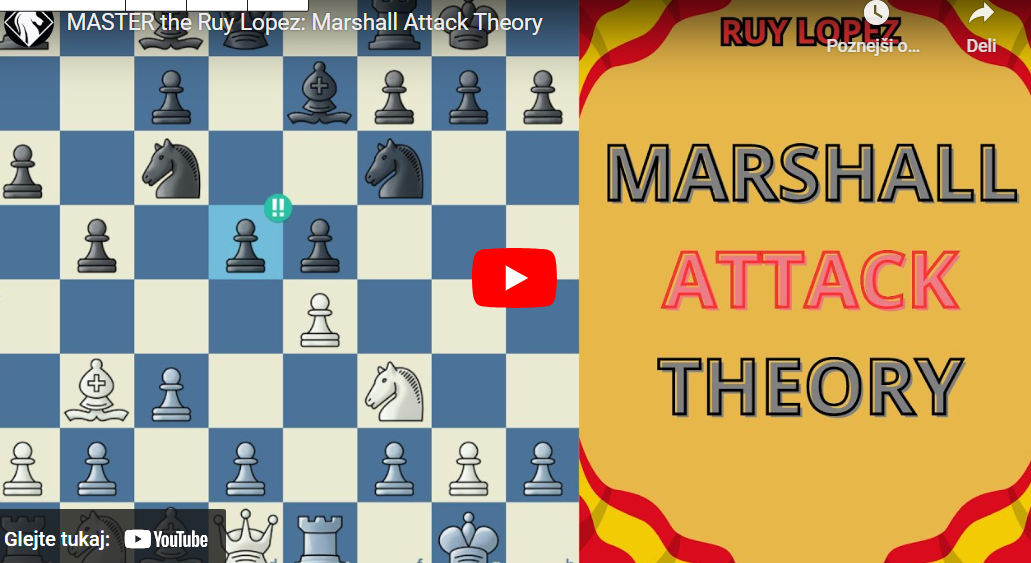
The Marshall Attack is one of the most aggressive and dynamic systems in chess, originating from the Ruy Lopez opening. First introduced by the American grandmaster Frank Marshall in 1918, the Marshall Attack remains a popular choice for players seeking an active counterattacking weapon against White’s 1.e4 opening. The main idea behind this bold gambit is to sacrifice a pawn in exchange for quick development and a powerful initiative, putting intense pressure on White’s position.
The Marshall Attack arises after the moves:
- e4 e5
- Nf3 Nc6
- Bb5 a6
- Ba4 Nf6
- O-O Be7
- Re1 b5
- Bb3 O-O
- c3 d5
Here, Black sacrifices a pawn after 9. exd5 Nxd5, aiming for rapid piece activity rather than material. The goal is to overwhelm White with threats, forcing them to play precisely to avoid a dangerous attack. What makes the Marshall Attack particularly effective is its practical nature—many players struggle to handle the aggressive and complex nature of Black’s attack, especially in rapid or blitz games.
Over the years, the Marshall Attack has been extensively studied by both amateurs and grandmasters. Notably, top players such as Garry Kasparov and Magnus Carlsen have employed it successfully, proving its relevance in modern chess. White can either accept the challenge and try to defend the extra pawn or play more cautiously to avoid the sharpest lines. However, even today, the Marshall Attack continues to catch opponents off guard, making it a valuable tool for players who enjoy tactical, dynamic positions.
To get a deeper understanding of this aggressive opening, check out this YouTube video that explains the key ideas and strategies behind the Marshall Attack. It offers an excellent visual breakdown of how Black can capitalize on the sacrificed pawn and unleash a powerful attack on White’s kingside.
For those interested in exploring more about this aggressive chess opening and its variations, resources like Forky Chess provide detailed analysis and strategies for mastering this iconic gambit. The Marshall Attack remains a fascinating and effective weapon in competitive play, continuing to surprise opponents at all levels of chess.